
Crab apple jelly.
Of love, connection, my Mum and fundraising for Mother Earth. Happy Mothers Day.

There’s a crab apple tree in the front garden of my mother’s house, where I grew up.
The crab apple tree has always been there in my memory. Mum and Dad moved into the house on the outskirts of suburban Melbourne seventy years ago next year, a day after my eldest sister Jenni’s first birthday, and with my sister Kathy on the way.
Mum tells us that when they moved in the back and front yard was knee high grass, with black ash filling in the depressions that once had been a creek. I remember seeing blue tongue lizards in the yard. But they were probably lizards that Kathy tried to keep - she got them from some boys at school who had caught them, probably down the swamps that were just a few streets away. She would keep them in a wooden box and feed them on mincemeat but not for long - they would always escape.
In between bringing up five kids and the rest of her busy life, Mum transformed this paddock into a garden. Her garden has been such an important part of her life ever since.
I asked her recently what she could remember about where the various plants had come from.
The grapefruit tree she remembers planting with her father, when he was visiting from Adelaide as he and Grandma used to do every second school holidays. Those visits would alternate with us visiting Adelaide - the long trip along the western highway in the Valiant - with Jenni, Kathy and me in the back seat and my younger sister Diana and brother Peter sitting on a mattress in the station wagon part behind.
‘Margaret’, her father said, “I don’t think the grapefruit is going to do very well there’.
Sixty or so years on it’s an enormous tree, six metres tall and equally wide, producing over 100 kg of grapefruit every winter.
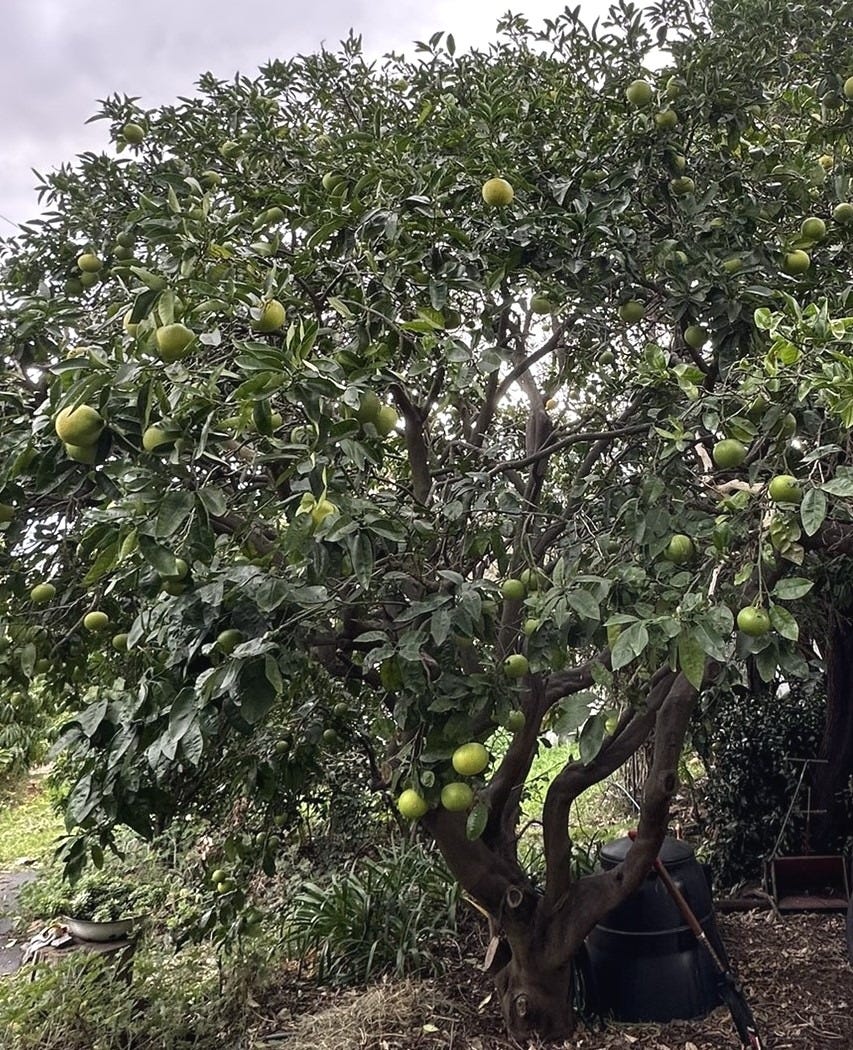
Unfortunately no one in the family really likes grapefruit - we didn’t inherit a taste for them from my father who used to eat one for breakfast every morning, cut in half, sprinkled with raw sugar before his bowl of cornflakes. But maybe he ate them because he felt he had to - you wouldn’t want them to go to waste. Dad grew up on a farm in the Mallee during the depression when nothing went to waste.
The grapefruit then and now mostly get given away - a box out by the front fence with a handwritten sign on cardboard inviting people to take them, a box by my front fence in Footscray, or taken to St Eanswythe’s church op-shop, or given away to friends and work colleagues. Despite these efforts there are many that are left for the possums and fruit bats to eat. They hollow them out, leaving yellow dried out shells in place of voluptuous breasts.
During June, July and August it’s a constant task to pick up and sort through the grapefruit into compost and giveaway piles. Usually there’s a batch of marmalade made each year - but although Mum often likes a slice of toast with just a thin spread of marmalade as part of her breakfast she doesn’t particularly like grapefruit marmalade- even when mixed with oranges and lemons to make her classic three fruits marmalade. So most of the marmalade gets given away too - and at any rate you only need at most four or five grapefruits in a batch of marmalade, so it isn’t really a solution to dealing with them!
‘How about the origins of the jacaranda, the white hibiscus, the crab apple?’ I asked Mum. ‘I don’t know, ‘ she replied. Mum’s memory is an interesting beast now. Lots of things lost in the mist of time and fragmenting and disintegrating neuro-connections, and those mists mixing up and confusing when things happened - everything everywhere all at once, with time in Mum’s mind now closer to being circular than linear.
Though then she recalled that Mrs Sipthorp, whose husband was the butcher across the road in the Somers Parade shops, used to have what Mum called ‘a miniature nursery’ on the vacant land next to the butchers shop. Maybe that’s where they came from.
Like the grapefruit, the crab apple is prolific. And even less edible than the grapefruit when raw. But very pretty when in fruit with pendulous clusters of plump red fruit. The only thing you can do with crab apples it seems ( and I’d love to know otherwise!) is to make crab apple jelly. Which Mum would do every year. Because it was such a waste to just let them drop to the ground. And they are messy that way! The possums and fruit bats don’t seem as interested in the crab apples as they are with the other fruit trees. Or at least the supply far outstrips their demand.
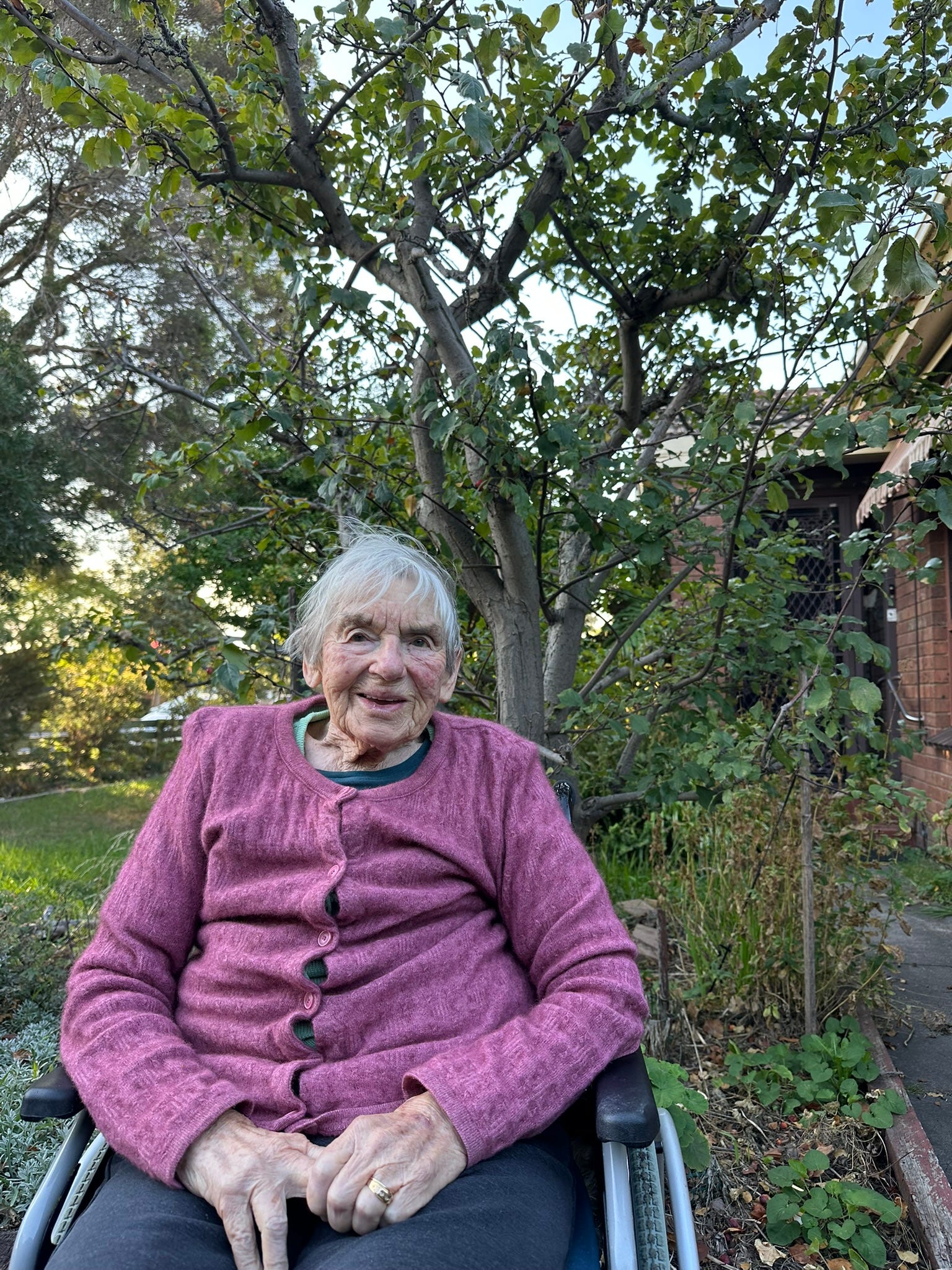
Of course fitting making crab apple jelly into a life filled with caring for kids, working as a kindergarten teacher, playing the church organ, supporting Karen refugees, organising events like the Mother’s Union Wave of Prayer for the Melbourne diocese, and the Altona Carols By Candlelight, often needed some serious juggling. We kids would be roped into picking the fruit - not as much fun as picking apricots in the summer, where gorging oneself on luscious ripe apricots, biting into warm soft flesh with sweet juice bursting into your mouth and down your chin was always a side benefit - crab apples just went straight into the bucket.
The crab apples would often then be stored in the crowded fridge, sometimes for weeks. Until they began to deteriorate and time needed to be found to turn them into jelly.
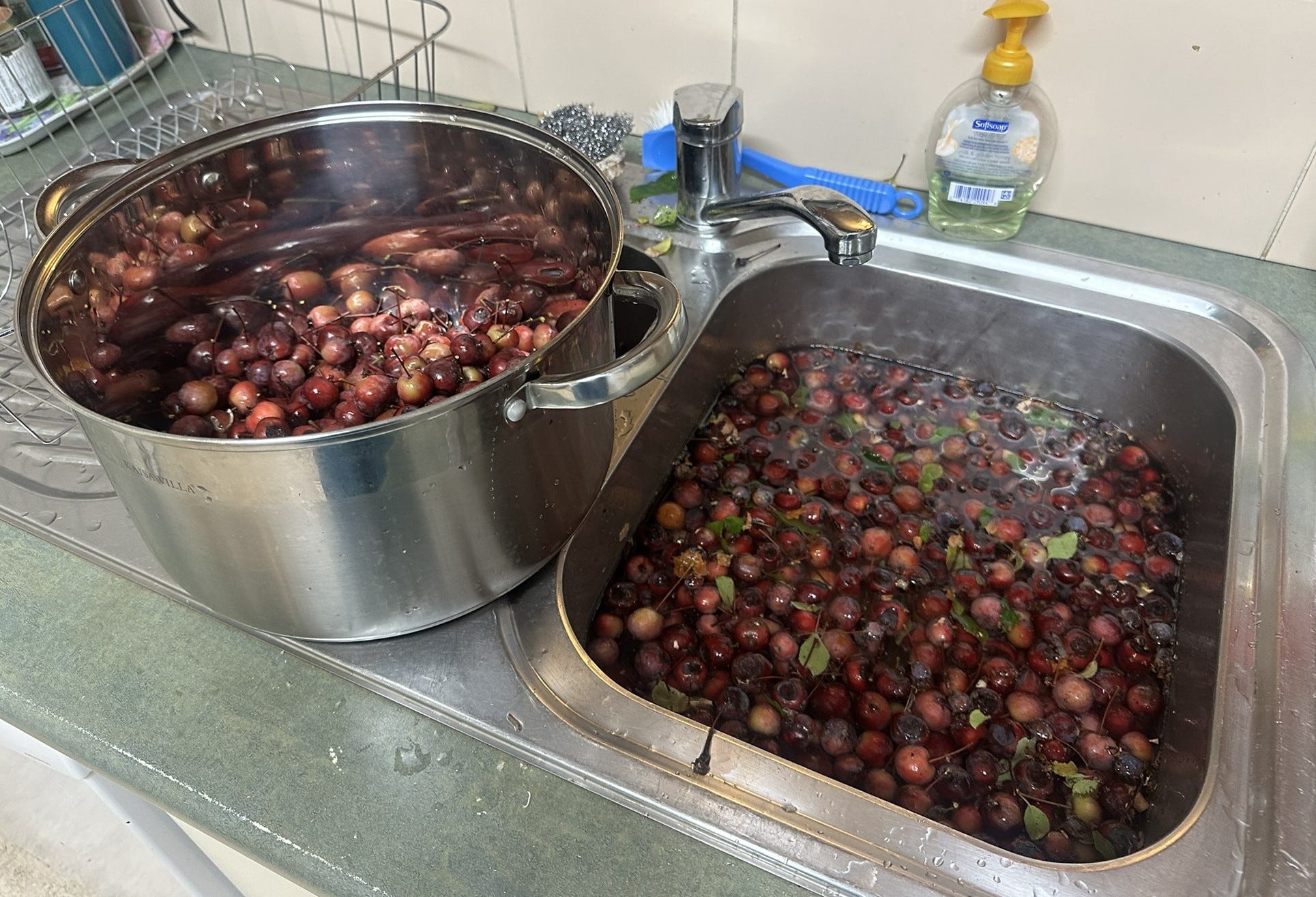
The next step for crab apple jelly is to wash them, stalks and all, removing any bad bits, then boiling them up until they are soft and mushy.
Then they need to be drained overnight. The recipes always say to drain through a muslin cloth. Mum never used a muslin cloth. The mushy crab apples were always drained through an old tea towel, one kept for that purpose, with the stains of crab apple jelly of years past embedded in its fabric, whites having turned to shades of reddy brown, frayed at the edges, the sky blue of the edges faded to a murky grey in the middle.
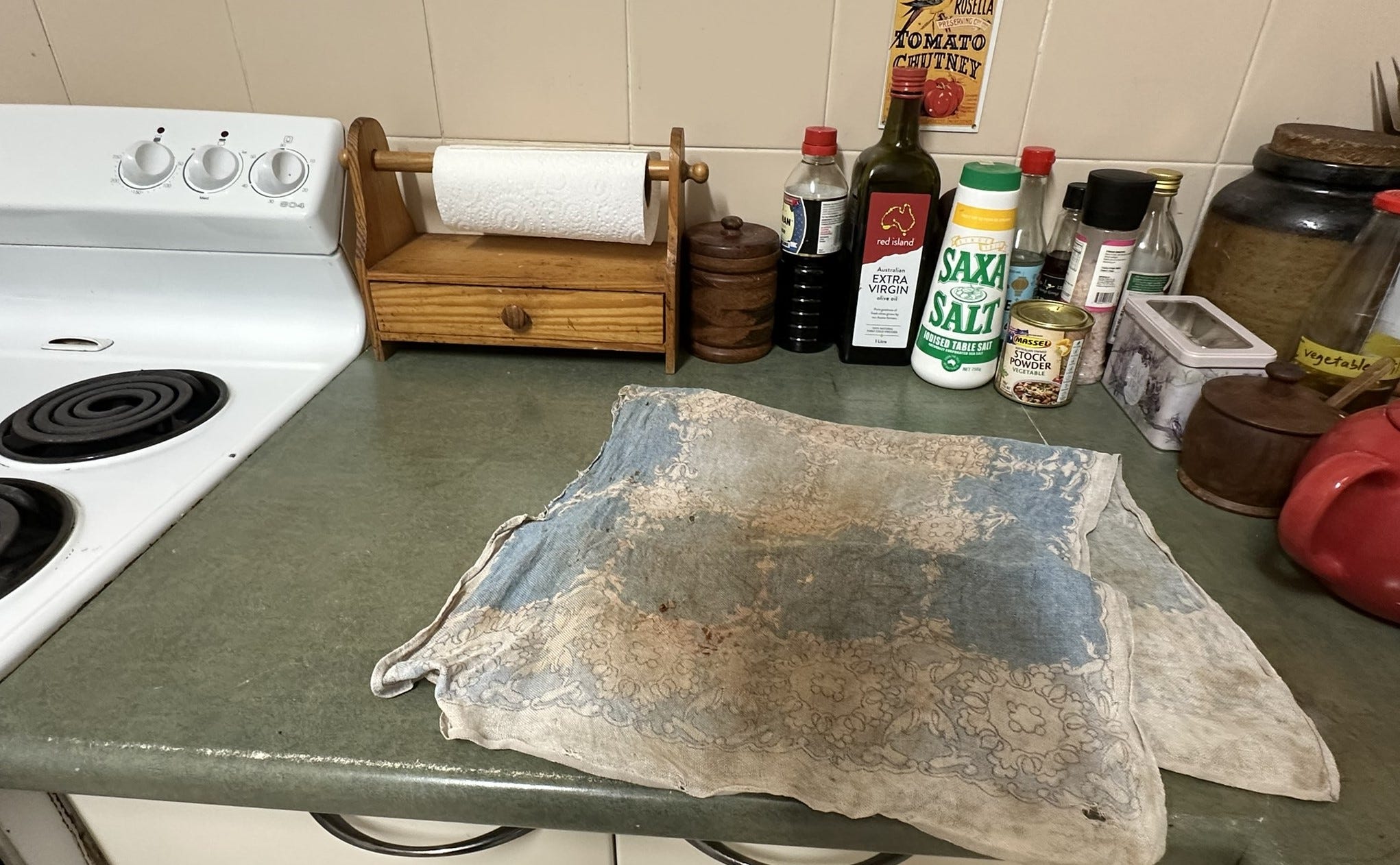
I think mum used to drain them the same way I do now - over a colander over a preserving pan, tied with a rubber band at the top.
Mum would often do this step in the late evening after a busy day, starting the washing of the fruit at around 9pm, tipping them into the colander an hour or more later.
Next morning, amongst the school lunches or getting us off to Little Athletics or maybe it was after church on a Sunday, she measured out the juice into the preserving pan. Not squeezing the tea towel full of fruit, even though you’re tempted to, to get just a bit more juice - that makes the jelly cloudy, they say. They say. I don’t know, I’ve never done it - you don’t want cloudy jelly!
Often, of course, the next day was busy. Work, kids, meetings… sometimes the drained crab apple juice would sit in the fridge for days, until mum had a clear enough window to actually make the jelly.
Sooner or later though the time had to come to get it underway. Usually again a late night in the kitchen. Late nights in the kitchen are something I’ve inherited from my mother. She had a short story cut out from an edition of the Women’s Day sometime in 1959 that we all related to - the Aunts in the Night who used to vacuum clean at 2am.
The next step is adding around 7 cups of sugar for every 10 cups of juice. When I’ve made crab apple jelly in recent years I’ve had to look up a recipe online - I can’t remember ever seeing Mum’s recipe written down. Mum and I agreed this year that 7 cups of sugar to every 10 cups of juice was about right - she’s not sure any more.
Some of the recipes online say a 1 to 1 ratio of sugar to juice but we both seemed to think that was too much. The other question was how much lemon juice to add? Mum can’t remember. Some recipes say none, some say the juice of a lemon to every 2kg of crab apples…I used three lemons this year for each massive plastic bowl of crab apples.
Just as significant as the boiling of the jelly is finding the jars - the right sized jars, smaller rather than larger is what you need. In Mum’s kitchen the bottom of the kitchen dresser is jammed full with old jars. Some years the jelly jars would be sealed with lids, some years they would be covered with Kleerview seals, the ones that you baste with vinegar before sealing. The jars need to be thoroughly washed and then sterilised - 15 minutes or so in a cool oven while the jelly bubbles away is usually enough. This year I cheated. I bought new jars just the right size.
Then wait until ‘setting point is reached’. Which you know through the ritual of dropping teaspoons of jelly on a cold saucer just out of the freezer, and running your finger through it, like Moses parting the Red Sea, and judging whether the channel you have made stays a channel or the puddle of jelly slowly merges back together. The nature of the simmering jelly changes too - it becomes slower,more rolling, more viscous.
By this stage you’ve got the jars are out of the oven, hot and dry, the lids if you are using them have also been boiled for ten minutes and have been dried out in the oven.
And using a small jug with a spout you fill the jars, and screw the lids on tight while they are still hot. Almost always you only end up with half as many jars filled as the number you had optimistically sterilised - that huge mass of crab apples has been distilled into iridescent shimmering treasure sitting gloriously on the kitchen bench.
Over the decades of Mum making jelly these gems were largely given away, mostly raising money for St Eanswythes and their Overseas and Outreach projects. Either given to the annual church bazaar or sold every Sunday through ad-hoc sales at the back of the church.
I’ve given mine away to friends and have supplies on hand for anyone who would like to take a jar, whenever I remember to offer it! Supplies that usually outlast the yearly cycle. I just checked - I have five jars of crab apple jelly and five jars of apricot jam from the 2024 summer in my pantry! They will still be fine - but not so good as gifts now they are over two years old!
This year I picked two big basins full of crab apples and made two batches of jelly, in early February and early April. The early April jelly was made from crab apples which had sat in the fridge for a month- they were late being picked at the start of March. Then I was busy… two and a half weeks in Dharamsala India with the Australia Tibet Council; the rest of my life jammed in around the trip…busy, like mother, like daughter...
I made each batch in Mum’s kitchen on days when I was caring for her, on her old electric stove, using her preserving pan, draining the jelly through the same worn tea-towel. Mum turns 94 at the end of this month and is living at home with 24/7 care. My sisters and I cover half of her care each week and paid carers the other.
Mum supervised the making of the February batch; but despite this expert attention we misjudged the setting point, and it didn’t set - so we needed to boil it up again with more lemon juice a week later. All good. Beauty and resilience.
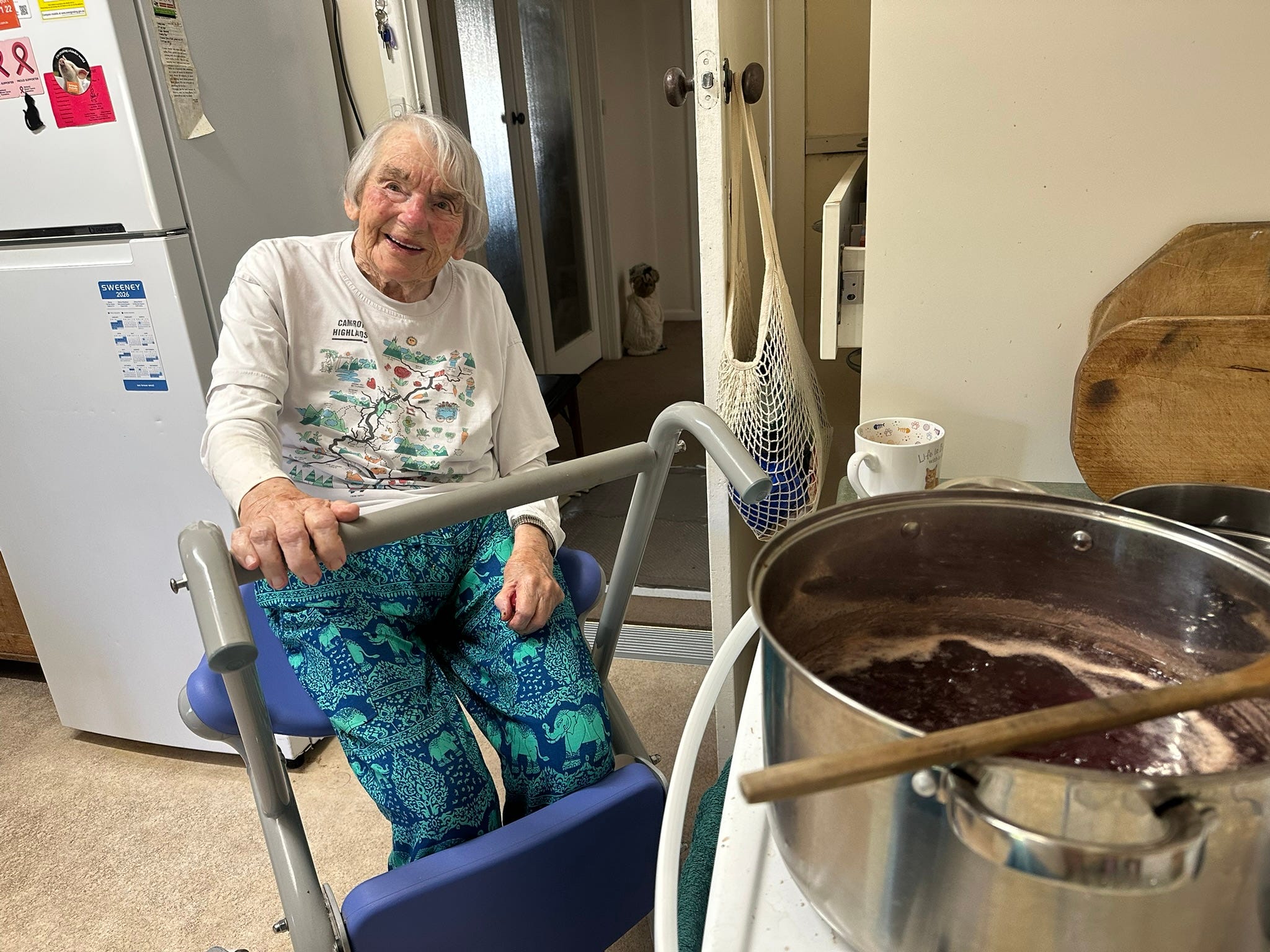
She slept through the making of the April batch. I boiled up the crab apples one evening after she had gone to bed, and made the jelly the following afternoon. I woke her from her afternoon nap with a cup of tea and a slice of toast with jelly.
There are now eighteen jars of crab apple jelly sitting glistening on my dining table. Eighteen jars to be given away.
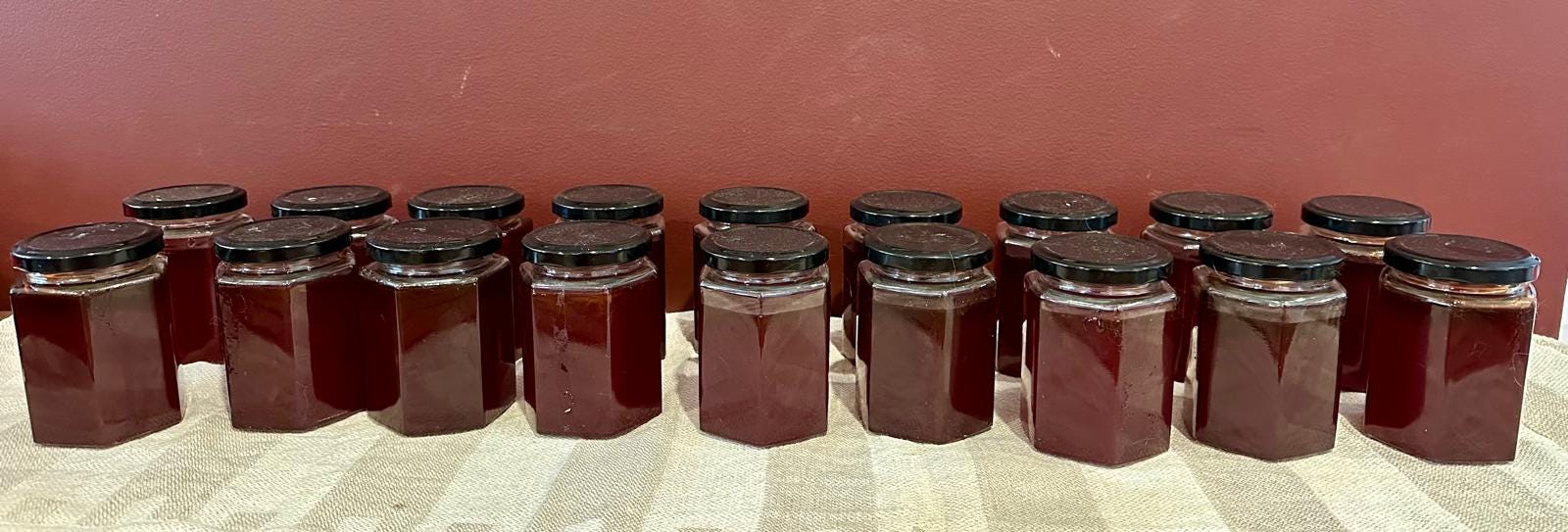
I am offering them as a gift to anyone who makes a donation to support the fundraising for climate campaigning that my partner Anne and I are currently doing. We are kayaking with 350.org in the Whitsundays next month, and are looking forward to gliding through glistening seas, with the love, beauty and resilience of gems and treasures of nature all around us.
Send us a donation, I’ll send you a jar of jelly, and I’ll invite you to imagine yourself there with us, connected with love, a thread from Altona and my Mum, to me, to the Whitsundays, to you, as you spread a shimmering, deep red, wobbly dollop on your morning toast.
My horse Diablo also liked the crab apples. And mum has remembered that the jacaranda likely came from the local Coles variety store - a damaged plant that had a broken branch and was being sold at a discounted price.
Happy Mother’s Day to Margaret and here’s to her gift of a bountiful garden and traditions of preserving that bounty. For many years after my mother passed away I savoured the plum jam that she’d made from the tree in the garden of our family home. She had labelled the jars and dated them - 2012. She died a little later that same year. At some point the jam ran out but memories of her and my gratitude for her care and providing continues.